






Introduction
Industrial manufacturing continues to evolve as businesses look for better ways to produce accurate components, manage production schedules, and respond to increasingly specialized customer requirements. Traditional metalworking techniques remain important, but modern manufacturing technology has introduced new opportunities to improve precision, repeatability, and production flexibility.
From digitally controlled cutting equipment to automated forming processes, technology is changing how manufacturers transform raw metal into finished industrial products.
These developments are particularly relevant for companies producing machinery, electrical enclosures, equipment housings, structural assemblies, and specialized components. By investing in appropriate manufacturing methods, suppliers can support more complex designs while maintaining consistent production processes.
For businesses requiring custom sheet metal fabrication services, understanding these technological developments can help when evaluating suppliers and planning future manufacturing projects.
The Shift From Traditional Metalworking to Digital Manufacturing
Traditional metal fabrication often involved substantial manual measurements, physical templates, and operator-controlled processes.
Although these techniques remain useful for particular applications, digital manufacturing has introduced greater control over many production operations.
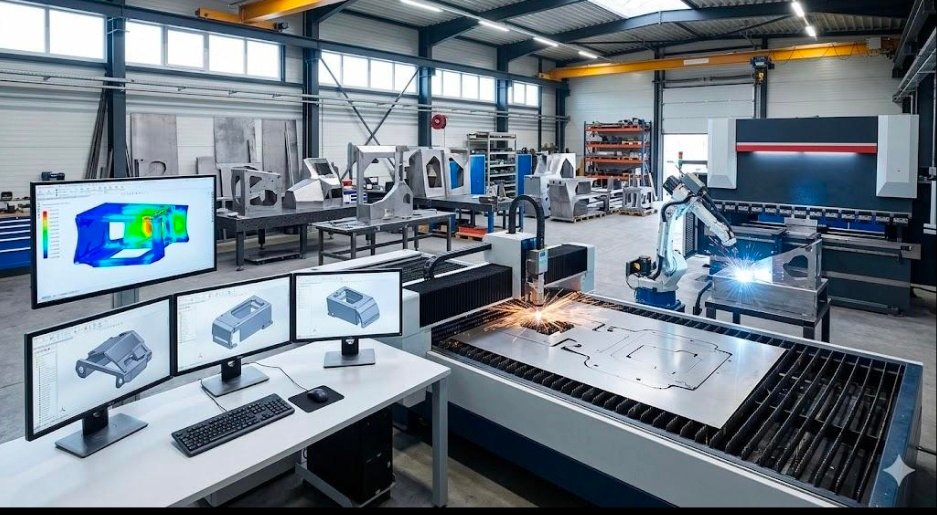
Engineers can now create detailed CAD models and convert approved designs into machine-readable instructions.
These digital files can guide cutting, punching, bending, and other manufacturing operations.
The result is a more connected workflow in which design information can move from engineering into production with fewer manual interpretation steps.
Digital manufacturing also makes it easier to manage design revisions. When a component changes, the corresponding production files can be updated to reflect the approved specifications.
CNC Technology and Production Repeatability
Computer Numerical Control, commonly known as CNC, is widely used in modern metal fabrication.
CNC machines operate according to programmed instructions, allowing manufacturers to perform specific operations with controlled movements and settings.
This technology is used in processes such as laser cutting, punching, bending, and machining.
One important advantage is repeatability. Once an appropriate program and setup have been established, similar components can be manufactured using consistent production instructions.
This is particularly useful for businesses that require repeated brackets, panels, mounting plates, and equipment housings.
However, CNC technology still requires suitable programming, tooling, material preparation, and inspection. Machine automation supports accuracy but does not remove the need for skilled manufacturing personnel.
Laser Cutting and Complex Component Designs
Laser cutting has become an important technology for producing detailed sheet metal components.
It uses a concentrated beam of energy to cut material according to a programmed profile.
Compared with some conventional cutting approaches, laser technology can accommodate intricate geometries and detailed openings.
This is valuable for components that require precise mounting holes, slots, cutouts, and external profiles.
Greater Design Flexibility
Digital cutting programs allow manufacturers to process different component shapes without creating a separate physical cutting template for every design.
This can be useful for product development projects involving multiple component variations.
Engineers can revise a CAD drawing, update the cutting program, and prepare the modified design for production.
Material Utilization
Laser cutting also works with nesting software that arranges multiple component profiles within a metal sheet.
Efficient nesting can reduce unused material and support better production planning.
The final result depends on sheet dimensions, component geometry, spacing requirements, and the selected cutting process.
Automated Bending and Precision Forming
Cutting produces flat components, but many industrial products require three-dimensional shapes.
CNC press brakes help manufacturers form metal sheets into angles, channels, brackets, panels, and enclosure structures.
Modern bending equipment can use programmed settings to control machine movements and production parameters.
Some systems also incorporate measurement or angle correction features to help compensate for material behavior.
This is particularly useful when manufacturing components with several bends that must fit accurately into a larger assembly.
Nevertheless, bending quality still depends on material thickness, grade, tooling selection, bend radius, and production setup.
An appropriate bending sequence is essential when a component contains complicated geometry.
The Growing Role of CAD and CAM Integration
Computer-Aided Design (CAD) and Computer-Aided Manufacturing (CAM) technologies support the relationship between engineering and production.
CAD software helps engineers create component drawings and three-dimensional models.
CAM software translates manufacturing requirements into instructions suitable for compatible machines.
Together, these technologies help connect product development with fabrication operations.
For example, an engineer designing a control cabinet can prepare the enclosure panels, openings, and mounting features in a digital model.
Manufacturing software can then help generate the necessary cutting and forming instructions.
This digital workflow can improve communication between engineering and production teams, particularly when a project involves multiple customized components.
Integrated Manufacturing and the Importance of Connected Capabilities
Industrial fabrication frequently requires several operations to complete a single product.
A typical project may involve cutting flat metal sheets, forming individual pieces, welding assemblies, machining specific features, and applying surface treatments.
If these operations are managed through separate suppliers, the manufacturer must coordinate different schedules, drawings, and quality expectations.
A connected production environment can simplify this arrangement.
Businesses comparing industrial metal fabrication capabilities should look at how different manufacturing processes work together rather than evaluating individual machines in isolation.
Relevant capabilities may include:
- Laser cutting and precision sheet processing.
- CNC punching and forming.
- Metal bending.
- MIG and TIG welding.
- Machining.
- Surface treatment and finishing.
- Hardware installation.
- Component assembly.
The ability to coordinate these processes can help manufacturers manage complex product requirements more effectively.
Robotics and Automation in Welding
Welding is another area where automation can support industrial production.
Robotic welding systems can perform programmed movements along defined joint paths.
They are particularly useful for repetitive welding operations involving suitable component geometries and consistent production requirements.
Automation can help maintain repeatable movement and process parameters, although the actual quality of a weld still depends on material preparation, joint design, programming, and inspection.
Manual welding also remains important for customized components, complex assemblies, and projects requiring flexible production arrangements.
The appropriate method depends on the design, quantity, material, and quality requirements.
Data and Smart Manufacturing
Manufacturing technology is increasingly connected with production data.
Machine monitoring systems can provide information about equipment utilization, operating conditions, production quantities, and machine performance.
This information can help production managers understand how manufacturing resources are being used.
For example, monitoring may reveal recurring machine downtime or production bottlenecks.
Manufacturers can use this information to review maintenance schedules, adjust production planning, and improve workflow organization.
Digital production records can also support traceability and provide useful information when investigating manufacturing issues.
The benefits depend on the quality of the collected data and how effectively businesses use it to make operational decisions.
Why Skilled People Remain Essential
Automation does not eliminate the need for manufacturing expertise.
Engineers still need to understand material properties, component geometry, manufacturing limitations, and product requirements.
Machine operators must prepare equipment, select appropriate tooling, monitor operations, and recognize abnormal production conditions.
Quality personnel also play an important role in verifying that finished components meet approved specifications.
Modern manufacturing works best when appropriate technology is combined with practical technical knowledge.
A highly automated machine cannot compensate for an incomplete engineering drawing or an unsuitable material specification.
Supporting Customization Without Complicating Production
One of the important advantages of digital manufacturing is the ability to handle product variations.
Industrial customers may require different component dimensions, mounting arrangements, finishes, or material grades.
Digitally controlled equipment can make these variations easier to manage when production programs and specifications are organized correctly.
This is useful for manufacturers serving multiple industries or producing equipment with configurable designs.
However, every customization still requires proper engineering review. Changes should be evaluated for manufacturing feasibility, assembly compatibility, and quality requirements.
Clear revision control is also necessary to prevent outdated designs from entering production.
Preparing for the Future of Metal Fabrication
The future of industrial metal fabrication will likely involve greater integration between digital design, machine automation, production monitoring, and quality management.
Manufacturers may increasingly use connected software systems to manage orders, engineering files, machine instructions, and production records.
Improvements in automation can also support more flexible manufacturing arrangements.
For customers, these developments create opportunities to work with suppliers capable of handling customized components and repeat production requirements through coordinated processes.
However, choosing a supplier should still involve practical evaluation of equipment, technical expertise, quality procedures, and project experience rather than relying solely on claims about advanced technology.
Conclusion
Modern manufacturing technology is transforming industrial metal fabrication through CNC equipment, laser cutting, automated bending, digital engineering, and improved production monitoring.
These technologies help manufacturers manage complex designs, improve process repeatability, and coordinate different production operations.
For industrial businesses, the most valuable approach combines modern equipment with accurate engineering information, suitable material selection, skilled personnel, and effective quality control.
As product requirements continue to evolve, manufacturers that integrate digital tools with practical fabrication expertise will be better positioned to support customized industrial components and changing production demands.